The builder

Quests

Twenty-four projects, grouped into six themes. The first five are about how work is changing, and the order matters, so start at the top. The sixth, Side quests, is the fun stuff: small things I built quickly, some of them in an afternoon.

Everything here stacks. Open Swarm was a spec; Sovereign Engine was built from it by the Agentics NZ community as a quest on Guild Hall. SASI@home was a demo of an AI swarm; unsorry is the swarm in action. Every project was built with the same ADRs, protocols and skills I publish, and this site is rendered from Iris, the tool at the top of the list. If I'm not using it, I don't get to preach it.

Everything I build, I build in the open. Star counts come straight from GitHub each time this page is built.

01

Re-imagining work

Tools that change what the work is, not just how fast it gets done.

Most AI tooling makes existing work faster. The projects here change what the work is.

Iris stores architecture as data rather than diagrams, so a model can be queried, extended by agents, and rendered. This site is rendered from an Iris model, which is the simplest demonstration of the idea. Gantry runs staged, gated processes from a repository: the data is captured once and each gate's document is rendered from it. Braintrust builds agent personas from the published work of people you follow, so you can consult them when you need to.

Iris

An architecture modelling tool that stores the architecture as data, not diagrams.
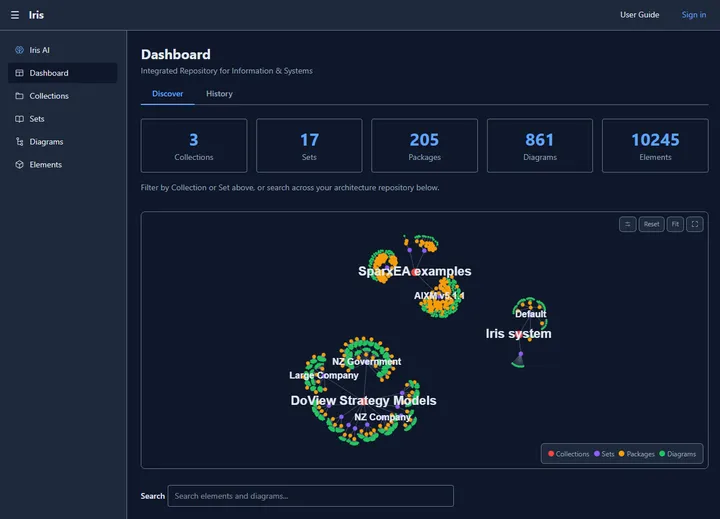
Iris

Most architecture tools treat the diagram as the source of truth, so models drift as they grow. Iris keeps elements, relationships and models in a knowledge graph, and diagrams are views onto it. It supports UML, ArchiMate and C4, and converts from Sparx EA.

An MCP server lets agents query and extend the repository directly. This site is rendered from an Iris collection at build time, so the page you are reading is a working example.
2026-02 6 stars, 2 forks

Gantry

A repository-driven pipeline for staged, gated processes. Capture the data once and render the document each gate needs.

Gantry

Staged approval processes spend most of their effort restating the same facts in whatever format the next gate asks for. Gantry keeps the data in the repository and renders each gate's document from it.

That means a business case, a review pack and a status report are no longer three documents that disagree with each other.

2026-09 1 stars, 0 forks

Braintrust

Agent personas built from the published work of people you follow, available on demand.

Braintrust

Most people follow a set of thinkers whose work they read. Braintrust builds agent personas from what those people publish, keeps them up to date, and lets any MCP client consult one persona or all of them at once.

A persona only speaks from the published record. It is a model of what someone has written, and it is labelled as one.

2026-07 1 stars, 0 forks
02

Standards & practice

How I work, written down and in use.

Everything here is the practice I use every day, written down so other people can use it and so I can be held to it.

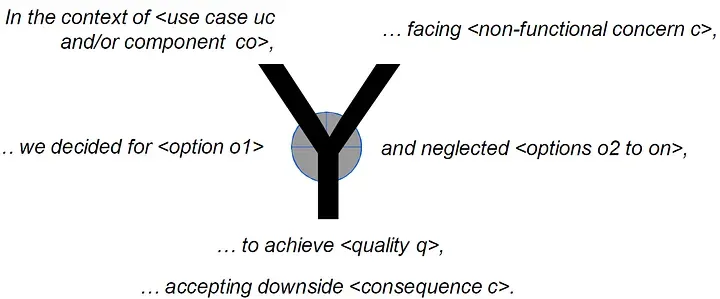
The ADR work extends Architecture Decision Records with the WH(Y) method, dependency tracking and governance metadata. It is the same discipline I introduced as standard practice at MSD, and it governs my own projects. Protocols sets out TDD, specs, feature branches and releases for agent-assisted delivery. Skills are the Claude skills I built and use.

Pipeline came first and has more stars than anything else I have made. It is retired, and says so here, because a method I have moved past is more useful as a marker than as a recommendation.

Pipeline

Superseded

The development pipeline my method started with. Now retired.

The most-starred thing I have published, and the first place I wrote down how I was actually working with agents.

It is superseded. Protocols, Skills and Gantry each took over part of what it did, and do it better. It stays listed because retiring a method in public is more useful than quietly leaving it up.

2025-02 44 stars, 8 forks

ADR

Architecture Decision Records extended with the WH(Y) method, dependencies and governance metadata.

ADR

A decision record that only says what was decided leaves out the part you need later: why. This format adds structured reasoning, dependencies between decisions, and the governance metadata a decision log needs at organisational scale.

I introduced ADRs as standard practice at MSD with executive endorsement. The projects on this site are governed the same way, with several hundred ADRs across Iris and unsorry alone.

2026-01 26 stars, 1 forks

Skills

The Claude skills I built and use: drop them into your .claude/skills directory.

A skill turns a working practice from advice into something an agent runs the same way every time.

These are the ones I use, published as they are rather than tidied up for an audience. Judging by the stars, the plain ones get used most.

2025-10 17 stars, 9 forks

Protocols

Engineering protocols for agent-assisted delivery: TDD, ADRs, specs, branches, releases.

Protocols

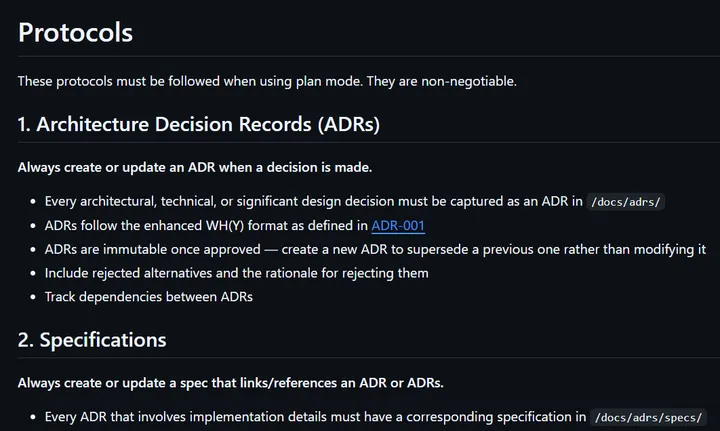
Agents will produce code that no established engineering practice would accept. Protocols writes those practices down in a form an agent reads before it starts: tests first, decisions recorded, specs followed, no duplication, production-ready.

Reference it in a prompt and the standards apply while the work is done, rather than being added at review.

2026-05 2 stars, 0 forks
03

Sovereign enablement

AI capability that communities own and run on their own hardware.

If the models that matter only run on infrastructure owned by a few companies, everyone else rents access. This theme is about the alternative.

The AI Blueprint is the oldest project here. In March 2024 it asked what a national AI strategy for New Zealand should look like, sixteen months before the government published one.

I should be clear about my part in the other two. Open Swarm is my specification for a mesh that runs small models on consumer hardware, and it has not been built. Sovereign Engine runs, and I did not write it: I set the direction, wrote the mesh spec, obtained the sponsorship and the hardware, and ran the build as a quest on Guild Hall while other people wrote the code.

The claim here is about getting other people's work pointed at something none of us would have built alone. It is not about the code.

Open Swarm

Planned

A distributed mesh for running small language models on consumer hardware.

Contribute spare CPU cycles to a mesh and get proportional access to its shared capacity: no subscription, no quota, no single owner. It is the clearest description I have of what community-owned AI capability would look like.

This is a specification, not a running system. It has documentation, planning, research and specs, but no source code. It is listed because the rest of this theme depends on the idea, and leaving that out would be misleading.

2025-07 4 stars, 1 forks

Sovereign Engine

Commissioned · Agentics NZ

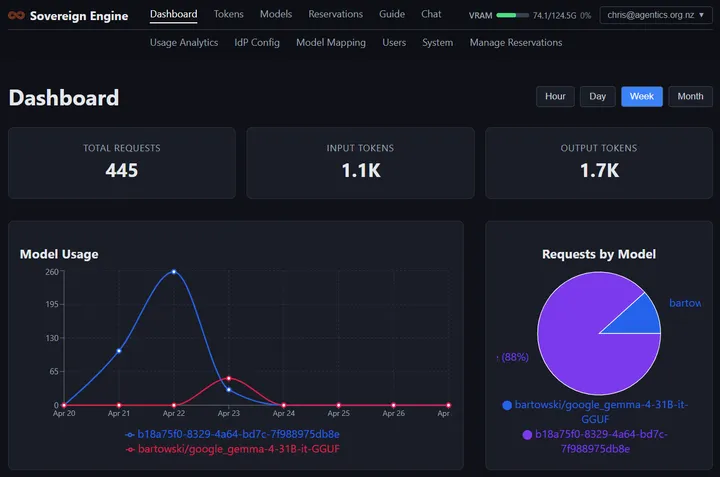
A Rust server that gives a community shared access to LLM models.

Sovereign Engine

Shared model access that a community runs for itself on its own hardware, instead of renting per seat.

I did not write this one. I set the direction, wrote the mesh specification it is based on, obtained the sponsorship and the hardware, and ran the build as a quest on Guild Hall. The engineering is the Agentics NZ community's. It is the best evidence I have that quest mechanics produce working software.

2026-04 2 stars, 0 forks

AI Blueprint for New Zealand

Crowd-sourcing a national AI strategy for the only OECD country without one.

AI Blueprint for New Zealand

Started in March 2024, when New Zealand was the only OECD country without a national AI strategy. The idea was that a blueprint could be crowd-sourced in the open instead of waiting for one.

New Zealand published Investing with Confidence, its first national AI strategy, in July 2025, sixteen months later. The date on this repository is the point, which is why nothing on this site is sorted by recency.

2024-03 3 stars, 1 forks
04

The game master

Quest-based experiences

Products that use quest mechanics to get people to take part and finish.

Framing work as a quest rather than a goal changes who takes part and whether they finish.

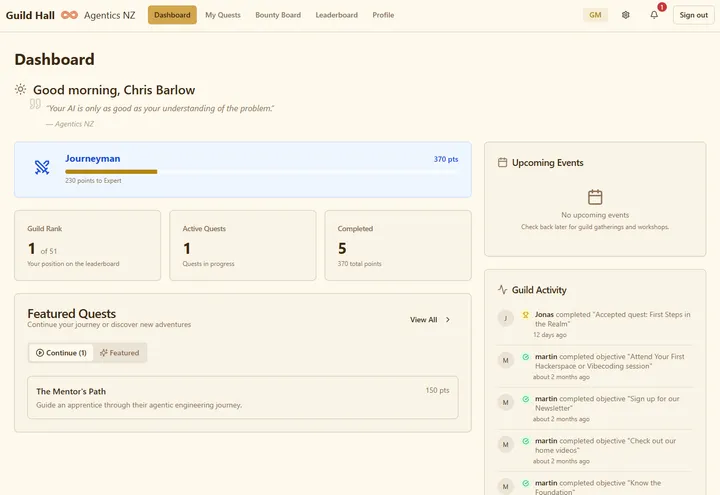
Guild Hall is where Game Masters design quests for a community and members complete them: accept a quest, submit evidence, earn standing. Sovereign Engine was built as a quest on it. Campaign Mode gives you a party of six AI advisors, based on Dr Simon McCallum's Six Animals framework, to argue with you before your work goes in front of anyone who matters. Uncharted Quests is where it started: a career progression framework run as a role-playing game.

This theme is about how engagement is designed. The smaller things I have built for fun are under Side quests.

Guild Hall

A platform where communities complete quests rather than checklists.

Guild Hall

Game Masters design quests for their community. Members browse the board, accept a quest, submit evidence, earn points and progress from Apprentice to Legend.

The test is whether real work comes out of it, not the badges. Sovereign Engine was built as a quest here. Meetups, learning communities and teams all have the same problem: a polite request to take part gets ignored.

2026-01 5 stars, 6 forks

Campaign Mode

Work with a party of AI advisors who each have a different perspective.

Campaign Mode

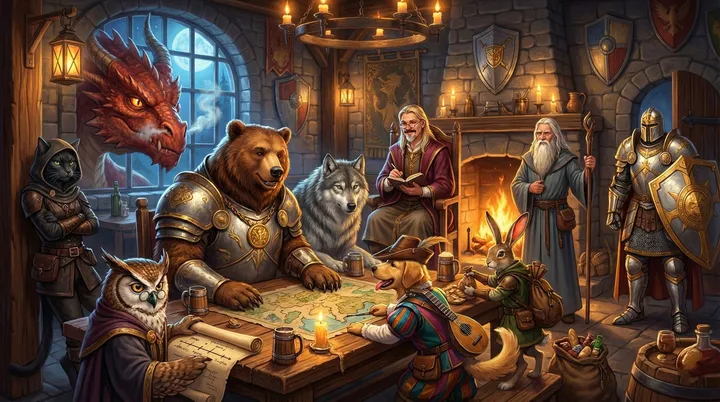
A single assistant agrees with you too easily. Campaign Mode gives you six advisors based on Dr Simon McCallum's Six Animals framework, each with a distinct outlook, to challenge your assumptions and find blind spots before the work goes anywhere important.

The work is framed as a quest, and what comes out has already survived an argument. Available as a plugin for Claude Desktop and Claude Code.

2026-02 3 stars, 0 forks

Uncharted Quests

The thinking behind quest-based experiences, set out in a series of articles.

Uncharted Quests

These articles set out the idea behind everything in this theme: frame work as a quest rather than a goal, and people take part and finish.

It began with the career progression framework I built for the Architecture practice at MSD. Development plans were dry, so I rewrote them as a role-playing game: each role a class with its own card, the full set an Architect's Role Compendium, and each career step a quest. From there the articles work the idea through a cooperative card game about how an architecture team delivers together, and Quest Buddy, a proof-of-concept app where anything can be a quest and finishing one earns a badge. Guild Hall is where the thinking became a product.

05

Experimental/R&D

Open questions, tested with working systems.

Questions I did not know the answer to, and the systems I built to find out.

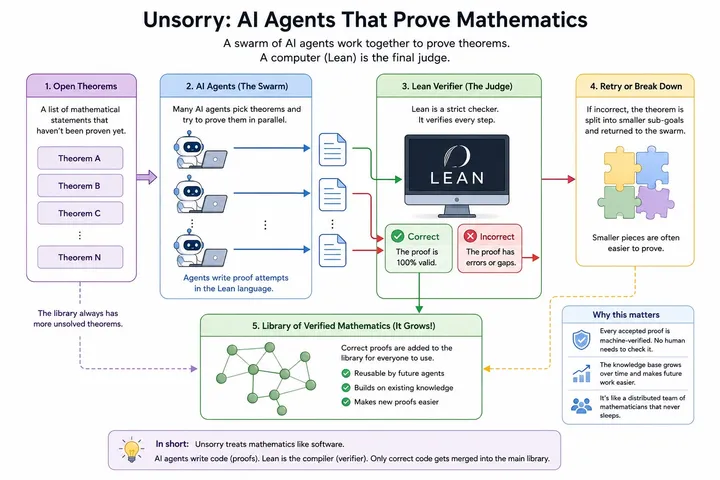
Unsorry is the larger of the two: a swarm of agents writing Lean 4 proofs, checked by a compiler that rejects anything unproven. Git is the queue, the compiler is the judge, and no sorry survives a merge. Failed proofs are split into sub-goals and sent back out; verified ones join a library that makes the next proof easier. I lead it, and a community runs the swarm.

Machine Dream asks a narrower question: what happens if a model keeps thinking when nobody is prompting it? It answers with a GRASP loop, consolidation cycles and persistent memory, tested on a problem with a verifiable right answer.

unsorry

Led · Agentics NZ

Autonomous agents proving theorems in Lean 4: SETI@home, but for maths proofs.

unsorry

A swarm of agents picks open theorems, writes proof attempts in Lean 4, and submits them to the Lean kernel, which only accepts complete proofs. Git is the queue, the compiler is the gate, and no sorry survives a merge. Failed attempts are split into sub-goals and sent back out; verified proofs join a library that makes later proofs cheaper.

It treats mathematics like software, and it is the strongest evidence I have that autonomous agents can be trusted when the checker cannot be fooled. I set the direction and lead the project; the community runs the swarm.

2026-06 41 stars, 12 forks

Machine Dream

What happens when a model keeps thinking after you stop asking?

Machine Dream

A platform for continuous machine cognition: a GRASP loop that keeps running between prompts, consolidation cycles that work like sleep, and memory that persists between them.

It is tested on Sudoku solved by the model alone. That is deliberate: every answer is verifiably right or wrong, so whether it learned anything is measured rather than guessed.

2026-01 21 stars, 5 forks
06

Side quests

Small self-contained builds you can use right now.

Smaller projects that make no argument about the future of work. They exist and they run.

Two are ADHD screening tools that people use. One is a browser recreation of David Braben's Lander, the first ARM game. One is a soft-body teddy bear made of 816 particles. SASI@home reimagines SETI@home for coordinated AI swarms, and has more stars than most of the projects I take seriously.

Afternoon builds and real tools sit side by side, because how quickly an idea can become a running thing is worth showing.

SASI@home

A SETI@home-style visualisation of distributed AI swarms.

Watch the swarm 10 stars, 1 forks

Architects of the Digital Realm

A text adventure about enterprise architecture, set in a modern office.

Source 5 stars, 1 forks

DIVA-5 ADHD Screener

An interactive adult ADHD screening tool based on the DIVA-5 diagnostic interview.

Young DIVA-5 ADHD Screener

The DIVA-5 screening tool adapted for ages 5 to 17.

Lander

A faithful browser recreation of David Braben's Lander: the first ARM game ever written.

Play it 0 stars, 0 forks

Matariki

A navigation demo built for Matariki 2025.

Open it 0 stars, 0 forks

Teddy

A soft-body teddy bear made of 816 particles and a lot of constraints.

Source 1 stars, 0 forks

Squeeze-out Simulator

An interactive look at housing, wages and wealth in the US and UK from 1880 to 2030.

Open the simulator 0 stars, 0 forks

slopgasm

A shameless experiment in making an AI band.

Listen 0 stars, 0 forks